Description
For the power generation plants planned in the Bergell area (Albigna) starting in the mid-Fifties and the extensive cement transport linked to it from Untervaz near Landquart to the Engadin area (up to 1,000 metric tons per day) the Rhaetian Railroad urgently needed more powerful locomotives with the following specifications: One unit alone had to be able to haul a train equipped for the largest permissible loads, which meant around 250 metric tons on a 3.5% grade (Albula Linie) and on a 4.5% grade (Küblis – Davos) around 180 metric tons. In cooperation with SLM (mechanical part) as well as BBC and MFO (electrical part) the result was a unit with three two-axle trucks and a locomotive body divided in the middle by articulation, which best met the requirements and especially the route conditions of the RhB. In 1955, two such class Ge 6/6 II locomotives were initially ordered and by mid-1958 were delivered with the road numbers 701 and 702. The outer trucks as well as the single phase series wound motors were identical with those of the Ge 4/4 I 601-610. The 294 kilowatt (400 horsepower) traction motors were controlled by a low voltage step relay controller corresponding to the level of the technology of that time. There were 28 speed levels with voltages of approximately 70 to 480 volts and 15 electric brake steps. The recuperative brakes worked on descending grades using the proven MFO excitation motor circuit.
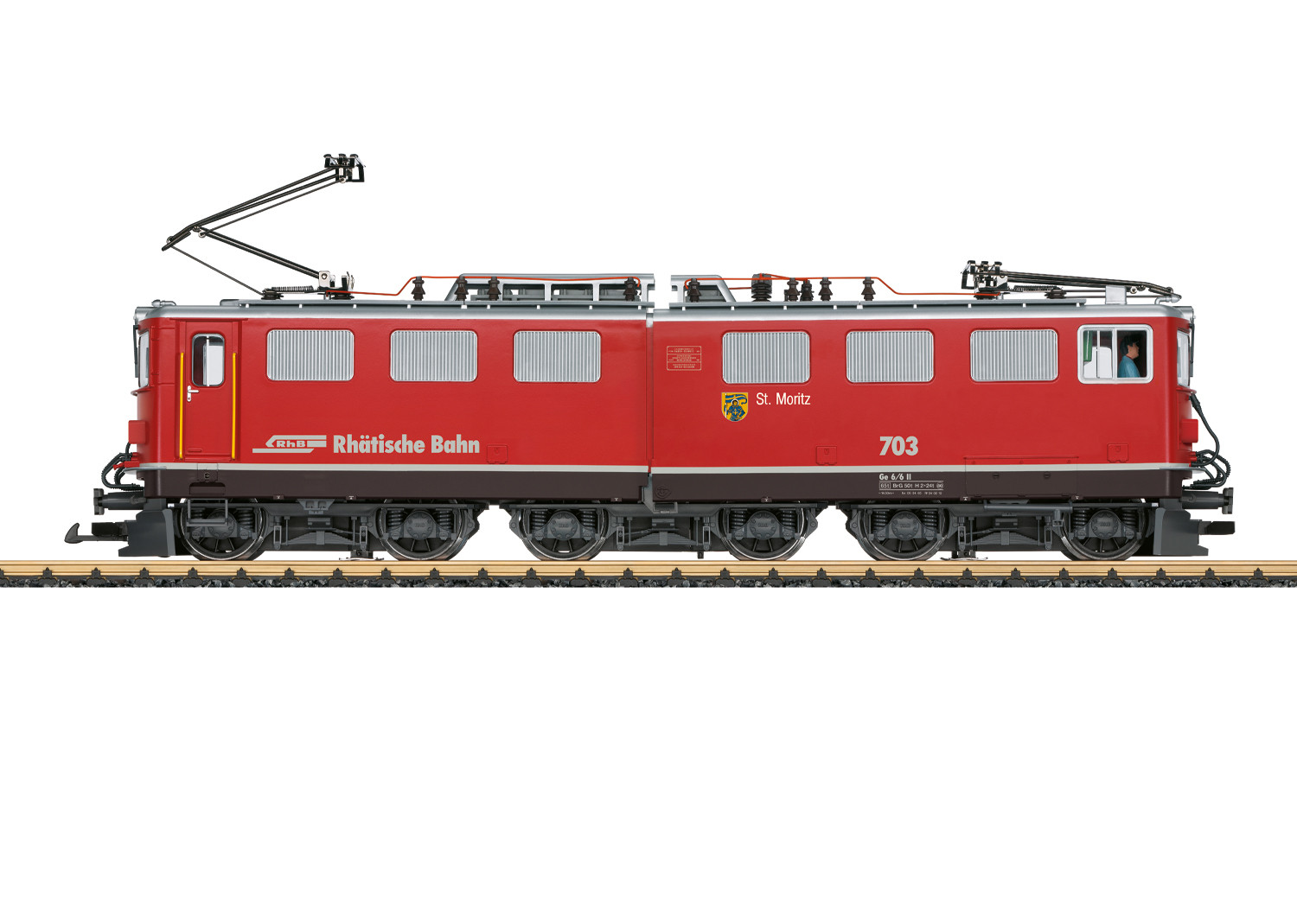
22064 Class Ge 6/6 II Electric Locomotive
Gauge / Design Type: G /
Era: VI
Type: Electric Locomotive
EAN: 4011525220640
- Length over the buffers 65 cm / 25-5/8“
- This is a model of a Rhaetian Railroad (RhB) class Ge6/6 II electric locomotive, road number 703 “St. Moritz”
- The paint scheme and lettering are prototypical for Era VI as the unit was last operated
- The lower headlight is rectangular in design
- Four wheelsets are driven by two powerful ball bearing Bühler motors
- The locomotive has an mfx/DCC decoder with many light and sound functions
- The single-arm pantographs are servo driven and can be raised and lowered digitally
- The articulation is correctly reproduced in the middle of the locomotive

Reviews
There are no reviews yet.